Seeing Stars: Astronomy in the Regency Period
By Regina Scott
We have been fascinated with the stars for millennia. Ancient priestess and royal wise men studied the skies for signs and wonders. That initial awe was replaced by the science of astronomy during the Renaissance. But it was in the Georgian and Regency periods that the Grand Amateur first arose-the wealthy, upper-class gentleman, or lady, who by interest, ability, and fortune, made major contributions to the science of astronomy and our understanding of the heavens.
Foremost among these amateurs was William Herschel. A Hanoverian by birth, Herschel came to England in 1757 at age 19 to teach music. By 1766, he was an organist in Bath and often served as choir master. However, at night, he studied the stars from his home at 19 New King St. (now the Herschel Museum). In 1781, he discovered the planet Uranus, which earned him the title of King's Astronomer, a knighthood, and a pension of 200 pounds per year. Such patronage from King George III was not surprising when you consider that the king was also a Hanoverian by birth and that Herschel had originally suggested naming the new planet after him.
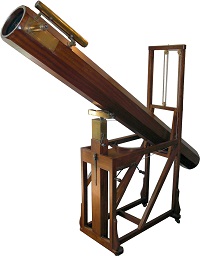
Herschel went on to discover four other major stellar bodies, outline the concept of asteroids, map the location of 848 binary stars, and conduct the first scientific survey of the Milky Way. He was elected a Fellow in the Royal Society, Britain's premier scientific organization, and was awarded its Copley Medal for his work. In his quest for better viewing equipment, Herschel learned to grind his own lenses, coat his own mirrors, and make telescopes. His skill was so great that other amateurs commissioned scopes from him, including the King of Spain. Through a grant from King George III, he built a 40-foot-long telescope with a 49-inch mirror at his new home in Slough, near Windsor, in what would be called Observatory House. It was the largest telescope in the world, and a source of many visitors, until the Earl of Roth, an Irish peer, build a larger scope in 1845.
At age 51, Herschel married a widow. Their child, John Herschel, was a mathematician in his own right, was admitted to the Royal Society in 1813, and took over his father's observations in 1816. In 1821, he was also awarded the Copley Medal for his work.
But William and John were not the only Herschels to participate in astronomy circles during the 1700s and 1800s. In 1772, William's younger sister Caroline (age 22) came to join him in England and was soon enlisted to help with his work. Caroline was delighted. Her father had attempted to teach her astronomy when she was younger; however, her mother had insisted that she learn nothing but household tasks. When Caroline came to work with William, he trained her first as a singer to help pay the bills. She appeared only where brother conducted, but sometimes five nights a week in Bristol and Bath before William was knighted.
Her brother also trained her as an astronomer and mathematician. She discovered three nebulae in 1783 and her first comet in 1786. A year later, King George awarded her a salary of 50 pounds a year to serve as an assistant to her brother. She went on to discover another seven comets before 1797, then began cross-referencing and correcting England's star catalog developed by John Flamsteed, the country's first Astronomer Royal (1646-1719).
Caroline helped educate her nephew John and assisted in his work as well. She was a frequent visitor of the Royal family in 1816, 1817, and 1818. When William died in 1822, she returned to Hanover, but continued her observations. While many reports today tout her as one of the first women to be awarded membership in the Royal Society, it was an honorary membership only and not until 1835 (age 85). However, at age 86 she was elected a member of the Royal Irish Academy and at 96 was awarded the Prussian Gold Medal for Science. She died in 1848.
One of the most exciting astronomical objects discovered during the Regency was the Great Comet of 1811. The comet, also called Flaugerges Comet, was discovered in France in late March but was most spectacular from October through the end of the year. In all, it was visible for over sixteen months. Only Comet Hale-Bopp in 1997 was visible longer in recorded history, and it was not as large.
The head diameter of the Great Comet was over 1.2 million miles, the largest of any comet observed. The tail was 110 million miles long, split into two branches like a crescent, with the head at the center. In contrast, the tail of Comet Hale-Bopp was only 30 million miles long. Cultures all over the world took the advent of the comet as a sign portending great changes. Napoleon too took it as sign, a sign of his divine right to rule. He attacked Russia that winter and met with his first significant defeat.
What began in the Georgian period extended to the Victorian. Grand Amateurs are credited with the discovery of the planet Neptune among other things. The tradition also expanded into other realms of science. The character of the wealthy peer turned scientist was so well known, in fact, that it began to appear in literature as well. Such classic characters as Jules Vernes' Phineas Fogg and Sir Arthur Conan Doyle's Sherlock Holmes immortalized the Grand Amateurs, giving them a prestige few enjoyed in life and giving us one more reason to be thankful for their work.
Try Starstruck to read more about my own Grand Amateur, Cassiopeia Bentbrooke, and her quest to discover a comet and her true love.